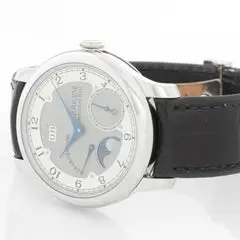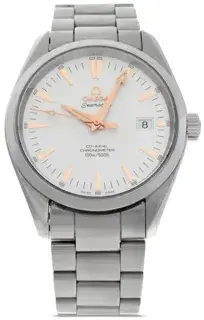
The Omega Speedmaster is the only chronograph whose movement history is also a manufacturing history: a hand-finished column-wheel calibre, replaced by a cam-actuated calibre built for volume, replaced sixty years later by a co-axial escapement certified to a tolerance no mechanical chronograph had previously been held to. Our database holds Speedmaster listings across 14 references with three or more examples each, and Omega auction results reaching $165,100. This article traces what changed inside the watch, and what the market pays for each step.
Calibre 321: column wheel, Lemania architecture, 1957 to 1968
The original Speedmaster ran the calibre 321, developed with Lemania as the CH27 C12. It is a hand-wound, column-wheel, lateral-clutch chronograph with 17 jewels, and our reference data confirms it in the 105.003, the reference worn by Wally Schirra and the last of the straight-lug cases.
Two things make the 321 mechanically notable. The column wheel coordinates the chronograph functions through a rotating castellated wheel, giving a progressive pushpiece action that cam systems do not replicate. And the movement is 27mm across with a 12-hour register, a proportion that let Omega fit a three-register chronograph into a compact case without stacking modules.
Commercially, calibre 321 references are the vintage tier. Our listings show the 145.012, the final 321 reference, averaging $29,860 across five examples with a range of $9,720 to $50,000, a fivefold spread driven almost entirely by dial and bezel originality.
Calibre 861: the cam-lever pivot, 1968 to 1996
In 1968 Omega replaced the 321 with the calibre 861, and the change is frequently mischaracterised as cost-cutting alone. What actually happened was a shift from a column wheel to a cam-and-lever (shuttle) system, and from 18,000 to 21,600 vibrations per hour.
The engineering logic: a cam system requires fewer precisely finished components and far less hand adjustment, making it more consistent at volume and cheaper to service. The tradeoff is pushpiece feel, which becomes more abrupt. The higher frequency improved rate stability. For a watch NASA had qualified for extravehicular activity and would keep buying in quantity, reproducibility mattered more than tactile refinement.
This is the reference band where the modern collector market is most liquid. The 145.022, the long-running 861 Professional, shows 10 listings averaging $72,872, but with a range from $2,808 to $187,500. That extreme spread is the single most important number in this article, and it deserves explanation.
The 145.022 ran from 1968 into the 1980s across many dial and caseback variants, including gold commemorative editions. Our data captures the BA145.022 gold Apollo XI editions separately, averaging $75,014 across seven examples with a top observation of $160,750. When a reference number spans steel tool watches and solid gold limited editions, the average is meaningless and only the variant matters.
Calibre 3861: co-axial escapement and METAS certification, 2019 to present
The current Moonwatch runs the calibre 3861, and it is the largest technical break in the watch's history. Three changes:
- Co-axial escapement. George Daniels' design replaces the sliding friction of a Swiss lever escapement with radial impulse across three wheels. Less sliding friction means less lubricant dependency, which is what allows longer service intervals.
- Si14 silicon balance spring. Silicon is non-magnetic and dimensionally stable with temperature. Omega rates the movement to 15,000 gauss, a threshold at which conventional steel hairsprings are rendered useless.
- Master Chronometer certification. Certified by METAS, the Swiss federal metrology institute, to 0 to +5 seconds per day, a tighter and asymmetric tolerance compared with COSC's -4 to +6 seconds. Critically, METAS tests the cased watch, including after magnetic exposure, where COSC tests the bare movement.
That last distinction is the one most often skipped. A COSC chronometer certificate describes a movement before it was cased; a METAS certificate describes the watch you actually wear.
What the current market pays
| Reference | Configuration | Listings | Average ask | Observed range |
|---|---|---|---|---|
| 310.30.42.50.01.002 | Moonwatch, sapphire, cal. 3861 | 24 | $7,610 | $6,800 to $8,625 |
| 310.30.42.50.01.001 | Moonwatch, hesalite, cal. 3861 | 20 | $6,578 | $6,000 to $7,475 |
| 310.32.42.50.02.001 | Moonwatch, gold accents | 17 | $16,820 | $14,999 to $19,995 |
| 310.30.42.50.04.001 | Moonwatch variant | 15 | $8,285 | $6,100 to $9,720 |
| 311.30.40.30.01.001 | Speedmaster CK2998 / heritage | 7 | $18,306 | $16,597 to $21,600 |
| 3570.50 | Professional, cal. 1861 | 5 | $5,107 | $4,520 to $5,742 |
| 145.022 | Vintage Professional, cal. 861 | 10 | $72,872 | $2,808 to $187,500 |
| BA145.022 | Gold Apollo XI edition | 7 | $75,014 | $8,100 to $160,750 |
| 145.012 | Final calibre 321 reference | 5 | $29,860 | $9,720 to $50,000 |
| 145.014 | Vintage variant | 6 | $3,035 | $2,160 to $4,000 |
Asking prices from our live listing database, $2,000 to $600,000 band, minimum three listings per reference. Updated nightly.
Hesalite or sapphire: the one specification that splits the current range
The two current Moonwatch references differ chiefly in crystal, and our data prices that difference precisely: $6,578 for hesalite (310.30.42.50.01.001) against $7,610 for sapphire (…01.002), a premium of roughly 16 percent.
The engineering case for hesalite is not nostalgia. Acrylic crazes rather than shatters, which is why NASA qualified it for spaceflight, and it polishes out with a mild abrasive. Sapphire resists scratching at 9 on the Mohs scale but fractures rather than deforms. The sapphire version also has a display caseback, which the hesalite version does not.
Auction context
Confirmed Omega results in our database show where scarcity concentrates: an Omega "Tourbillon 30 I" against a $60,000 to $120,000 estimate sold for $165,100; a modern Speedmaster ref. 310.55.42.50.99.002 estimated at $50,000 to $100,000 sold for $107,950; and a ref. 3695.59.31 estimated at $20,000 to $40,000 sold for $76,200, 91 percent above its high estimate.
The pattern differs from Rolex. Omega's top results cluster around precious-metal limited editions and historically significant pieces rather than dial variants of a single reference, which makes Omega collecting somewhat more legible: the scarce things are scarce by design and documented as such.
Practical guidance
If you want the watch as an instrument, the current 3861 references are objectively the most capable Speedmasters ever made, and the hesalite version is the cheaper and more historically faithful of the two. If you want the 321, budget for authentication rather than for the watch alone. And treat any 145.022 price in isolation as uninformative until you have established which variant is in front of you.
Live Speedmaster listings are on our Speedmaster listings page, with realized prices on our auction results page. Current specifications and METAS certification details are published by Omega.
Methodology
Listing figures aggregate our own nightly collection, filtered to a $2,000 to $600,000 sanity band with a minimum of three listings per reference. Calibre and jewel-count data come from our reference database. Auction figures are realized prices including buyer's premium as reported by the house. Full approach on our methodology page.