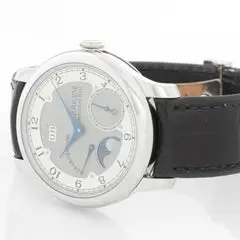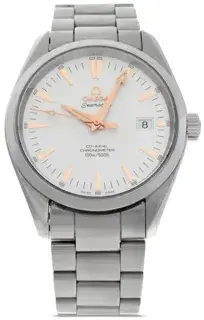
The Seamaster is where Omega deploys its engineering arguments, and our specification data shows why: across the line we record calibres rated from 30 ATM to 60 ATM water resistance, all sharing a co-axial escapement and a 60-hour power reserve. Our database holds Seamaster listings across 12 references with four or more examples, averaging between $3,853 and $8,409. This article examines the mechanism, the certification, and why this is the most technically capable watch at its price point.
The co-axial escapement: what it actually changes
Every mechanical watch loses energy at the escapement, and in a conventional Swiss lever the loss is mostly sliding friction. The pallet stones slide along the escape wheel teeth as they lock and unlock. Sliding contact requires lubricant, lubricant degrades, and as it degrades the rate drifts. That is the fundamental reason mechanical watches need servicing on a schedule.
George Daniels' co-axial escapement, which Omega industrialised from 1999, replaces most of that sliding with radial impulse. It uses three wheels on two levels rather than one, and the impulse is delivered close to perpendicular to the wheel's motion instead of dragged along it. The practical claim is reduced lubricant dependency, which translates into longer service intervals and more stable long-term rate.
It is worth being precise about what this does not do. A co-axial escapement is not inherently more accurate on day one than a well-adjusted lever escapement. Its argument is about accuracy over time, between services.
Master Chronometer: why METAS is a harder test than COSC
Omega's current Seamasters carry Master Chronometer certification, and the distinction from COSC is the most consequential specification detail in the range.
COSC tests a bare movement over 15 days across five positions and three temperatures, requiring an average daily rate of -4 to +6 seconds. The movement is then cased, regulated further, and sold, but the certificate describes it before that happened.
METAS, the Swiss federal metrology institute, tests the fully cased watch across eight criteria and requires 0 to +5 seconds per day. Two differences matter beyond the tighter tolerance. The range is asymmetric: a Master Chronometer may run fast but effectively may not run slow, which is the more useful behaviour for a wearer. And the watch is tested after exposure to a 15,000 gauss magnetic field, then again to confirm it survived.
That magnetic figure is not marketing. A conventional steel hairspring is disturbed by fields around 60 to 100 gauss and can be permanently magnetised by a laptop speaker or a magnetic clasp. Omega's silicon Si14 balance spring is non-ferrous and simply does not respond to magnetism, which is what allows the 15,000-gauss rating.
The calibre family, from our specification data
| Calibre | Power reserve | Jewels | Water resistance | Typical case |
|---|---|---|---|---|
| 8400 | 60 hours | 39 | 30 ATM | 41mm Aqua Terra / Diver |
| 8500 | 60 hours | 39 | 10 to 15 ATM | 38 to 41.5mm Aqua Terra |
| 8501 | 60 hours | 39 | 15 ATM | 41.5mm, precious metal |
| 8601 | 55 hours | 39 | 15 ATM | 38.5mm annual calendar |
| 8605 | 60 hours | 38 | 60 ATM | 43.5mm Planet Ocean |
Specifications from our reference database. ATM figures are the manufacturer's stated rating.
The 8605 at 60 ATM is the technically notable entry: 600 metres of rated depth with a co-axial escapement and a 60-hour reserve. For context, a Rolex Submariner is rated to 30 ATM. The 8605 doubles that in a movement carrying the same escapement architecture as the dress-oriented 8500.
Note also that the 8601 annual calendar gives up 5 hours of reserve (55 against 60) for the calendar mechanism, a small, honest trade that manufacturers rarely spell out.
What the market pays
| Reference | Configuration | Listings | Average ask | Observed range |
|---|---|---|---|---|
| 217.30.42.21.01.002 | Planet Ocean chronograph | 7 | $8,409 | $8,200 to $8,699 |
| 234.10.39.20.01.001 | Diver 300M, 39mm | 8 | $6,491 | $5,645 to $7,352 |
| 234.30.41.21.01.001 | Diver 300M, 41mm | 10 | $5,847 | $4,647 to $6,735 |
| 210.30.42.20.10.001 | Diver 300M, steel | 8 | $5,751 | $5,400 to $6,030 |
| 165.024 | Vintage Seamaster 300 | 9 | $5,643 | $2,300 to $7,560 |
| 210.30.42.20.04.001 | Diver 300M, black dial | 8 | $5,596 | $4,968 to $5,999 |
| 210.30.42.20.03.001 | Diver 300M, blue wave dial | 11 | $5,483 | $4,595 to $7,925 |
| 210.30.42.20.01.001 | Diver 300M, white dial | 9 | $5,272 | $4,500 to $5,800 |
| 210.32.42.20.03.001 | Diver 300M, rubber strap | 9 | $4,693 | $4,395 to $4,995 |
| 2220.80.00 | Previous-generation Diver 300M | 8 | $4,597 | $4,150 to $5,000 |
| 233.30.41.21.01.001 | Aqua Terra 41mm, cal. 8400 | 22 | $4,194 | $3,020 to $6,372 |
| 2531.80 | Bond-era Diver 300M | 7 | $3,853 | $3,299 to $4,200 |
Asking prices from our live listing database, $1,500 to $200,000 band, minimum four listings per reference. Updated nightly.
Four observations
This is the best specification-per-dollar in our entire dataset. The Aqua Terra 233.30.41.21.01.001 averages $4,194 and carries calibre 8400: co-axial escapement, silicon balance spring, 60-hour reserve, 30 ATM, Master Chronometer certified. Comparable Rolex references in our data with a 70-hour reserve and no magnetic certification average three to four times that.
Strap choice is priced at 12 percent. The 210.32.42.20.03.001 on rubber averages $4,693 against $5,483 for the 210.30.42.20.03.001 on bracelet. Same watch, same calibre, and the steel bracelet accounts for nearly $800.
The 39mm commands a premium over the 41mm. The 234.10.39.20.01.001 averages $6,491 against $5,847 for the 41mm 234.30.41.21.01.001, an 11 percent premium for the smaller case. That is consistent with the Explorer's return to 36mm: the market is moving back toward smaller sports watches.
Bond-era references are the cheapest entry. The 2531.80 averages $3,853 across seven listings with a tight $3,299 to $4,200 band. It predates the co-axial era, carrying a modified ETA-based automatic, which is precisely why it is inexpensive.
Practical guidance
If the objective is maximum mechanical capability for the money, the co-axial Aqua Terra at roughly $4,200 is the strongest case in our data and the argument is not close. For diving specifically, the 8605-powered Planet Ocean references give 60 ATM, double a Submariner's rating. Choose bracelet over rubber only if you value it above the roughly $800 it costs. And treat any pre-2007 Seamaster as a different proposition: no co-axial escapement, no silicon hairspring, no METAS certification, and priced accordingly.
Live Seamaster listings are on our Seamaster listings page, with realized prices on our auction results page. Master Chronometer criteria and calibre specifications are published by Omega, and the certification standard is administered by METAS.
Methodology
Listing figures aggregate our own nightly collection, filtered to a $1,500 to $200,000 sanity band with a minimum of four listings per reference. Calibre, jewel count, power reserve and water resistance data come from our reference database. Full approach on our methodology page.