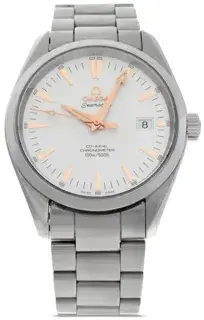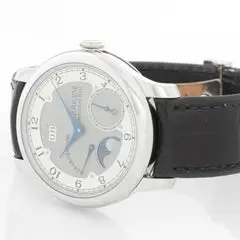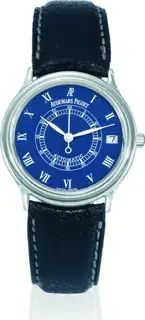
The Audemars Piguet Royal Oak is usually discussed as a design object, which obscures the more interesting fact: for fifty years its defining reference was built around one of the thinnest automatic movements ever put into series production, and when Audemars Piguet retired that movement in 2022 it changed the watch fundamentally. Our database holds Royal Oak listings across 12 references with three or more examples, plus Audemars Piguet auction results reaching $508,000. This article examines the mechanical substance beneath the octagonal bezel.
Calibre 2121: forty-five years of a 3.05mm movement
The original 1972 Royal Oak ref. 5402 ran the calibre 2121, derived from the Jaeger-LeCoultre 920 of 1967. Our reference data confirms it still in the 15202ST "Jumbo" with a 40-hour power reserve in a 39mm case.
Its significance is dimensional. At 3.05mm thick, the 2121 remained for decades the thinnest full-rotor automatic movement in production. Two design decisions made that possible:
- A peripheral rotor bearing. Rather than mounting the winding rotor on a central post above the movement, the 920 runs it on a ball-bearing race at the movement's edge. The rotor sits within the movement's height rather than on top of it, which is where the millimetres are recovered.
- No shock protection on the balance in original form. The architecture prioritised thinness to a degree that limited robustness, part of why the 2121 was always a dress-watch movement in a sports-watch case.
The consequence is that the Jumbo's famous 8.1mm case height is not a styling achievement, it is a movement achievement. No thicker calibre could have produced that profile.
Calibre 4302 and the 2022 transition
When AP retired the 2121, the replacement went in the opposite direction on every axis. Our specification data shows the calibre 4302 in the 15210 series delivering a 70-hour power reserve in a 41mm case.
The tradeoff is explicit and worth stating plainly: the 4302 offers 75 percent more running autonomy than the 2121's 40 hours, a modern free-sprung balance with variable inertia, a 4Hz rate, and full shock protection. It is a materially better movement by every measure of durability and convenience. It is also thicker, which is why the 15210 measures 41mm and cannot reproduce the Jumbo's silhouette.
This is the central tension in current Royal Oak collecting. The mechanically superior watch is not the one the market treats as the icon.
What the market pays, reference by reference
| Reference | Configuration | Listings | Average ask | Observed range |
|---|---|---|---|---|
| 26331ST.OO.1220ST.01 | Chronograph, steel | 9 | $46,882 | $41,753 to $53,420 |
| 26238ST.OO.A340CA.01 | Offshore chronograph, steel | 12 | $45,673 | $42,000 to $50,995 |
| 26331ST.OO.1220ST.02 | Chronograph, steel, alt dial | 8 | $45,641 | $41,800 to $50,773 |
| 15500ST.OO.1220ST.02 | Selfwinding 41mm, steel | 10 | $40,641 | $20,000 to $47,090 |
| 15500ST.OO.1220ST.04 | Selfwinding 41mm, steel | 10 | $40,032 | $20,400 to $44,875 |
| 15400ST.OO.1220ST.02 | Selfwinding 41mm, predecessor | 8 | $35,086 | $32,232 to $40,250 |
| 26401RO.OO.A002CA.02 | Offshore chronograph, rose gold | 8 | $34,967 | $33,013 to $40,420 |
| 26420TI.OO.A027CA.01 | Offshore chronograph, titanium | 12 | $31,308 | $25,449 to $37,000 |
| 67601ST | Royal Oak, steel, ladies' size | 11 | $24,616 | $13,651 to $36,800 |
| 26400SO.OO.A002CA.01 | Offshore, ceramic bezel | 10 | $22,082 | $19,370 to $27,825 |
| 15703ST.OO.A002CA.01 | Royal Oak Offshore Diver | 10 | $17,277 | $14,623 to $20,875 |
Asking prices from our live listing database, $8,000 to $900,000 band, minimum three listings per reference. Updated nightly.
Three patterns in the data
Chronographs command the premium, not the time-only. The 26331ST chronograph averages $46,882 against $40,641 for the 15500ST time-only in the same steel and size. That inverts the usual assumption that the purest expression carries the highest price.
Titanium trades below steel. The titanium 26420TI averages $31,308 while the steel 26238ST averages $45,673. Titanium is lighter and more expensive to machine, but the market treats it as the less desirable finish in this line.
Generational succession is priced modestly. The 15500ST replaced the 15400ST with a revised dial and movement, and the market gap is roughly 14 percent ($40,641 against $35,086). Compare that with the Rolex Daytona's near-parity between generations and a pattern emerges: buyers in integrated-bracelet sports watches pay for configuration and metal far more than for calibre updates.
Auction evidence: where the extremes sit
Confirmed Audemars Piguet results in our database show the top of the market is dominated by complications and precious metal rather than steel:
- Ref. 15412BA yellow gold, estimate $200,000 to $400,000, sold $406,400.
- Ref. 26579CS perpetual calendar in ceramic, estimate $250,000 to $500,000, sold $406,400.
- Ref. 25902OR rose gold, estimate $100,000 to $200,000, sold $317,500, 59 percent above high estimate.
- Ref. 5402, the original 1972 A-series, estimate $80,000 to $160,000, sold $279,400, 75 percent above high estimate.
The 5402 result is the historically meaningful one. The very first Royal Oak reference, running the 2121, achieved nearly twice its high estimate. That is the market pricing provenance and originality on the watch that created the category.
Practical guidance
If mechanical capability is your priority, the 4302-powered 15210 series is the better watch: 70 hours of reserve, modern shock protection, and a movement designed to be serviced for decades. If the Jumbo silhouette is the point, understand that you are buying a 3.05mm movement with a 40-hour reserve and dress-watch robustness, and price accordingly. For the Offshore line, note that our data shows tighter price ranges than the standard Royal Oak, suggesting a more efficient and better-understood market.
Live Royal Oak listings are on our Royal Oak listings page, and realized prices on our auction results page. Current specifications are published by Audemars Piguet; the base 920 calibre history is documented by Jaeger-LeCoultre.
Methodology
Listing figures aggregate our own nightly collection, filtered to an $8,000 to $900,000 sanity band with a minimum of three listings per reference. Calibre, case dimension and power reserve data come from our reference database. Auction figures are realized prices including buyer's premium as reported by the house. Full approach on our methodology page.