On the evening of 9 November 2019, in a ballroom at the Four Seasons Hotel des Bergues in Geneva, a stainless steel wristwatch sold for 31 million Swiss francs. The bidding took twelve minutes. It opened at 5 million francs and climbed in steps of 500,000 to 1 million until a single telephone bidder, who has never been publicly identified, was left alone at a number more than ten times the high estimate. The watch was the Patek Philippe Grandmaster Chime reference 6300A-010, and it remains the most expensive wristwatch ever sold at auction.
This is the story of how a watch in the least precious metal Patek Philippe works with became the most valuable object of its kind, and why that outcome was less strange than it first appears.
The result, in numbers
| Detail | Record |
|---|---|
| Reference | 6300A-010 |
| Sale | Only Watch 2019, eighth edition |
| Auction house | Christie's |
| Date | 9 November 2019 |
| Location | Four Seasons Hotel des Bergues, Geneva |
| Lot | 28 |
| Estimate | USD 2,000,000 to 2,500,000 |
| Result | CHF 31,000,000, roughly USD 31.2 million |
| Multiple of high estimate | Over 10x |
| Buyer | Anonymous, bidding by telephone |
The 31 million francs represented more than 80 percent of the entire auction total of CHF 38,593,000, which was raised across roughly fifty lots donated by watchmakers. Every franc went to research into Duchenne muscular dystrophy, a degenerative genetic condition that affects around one in 3,500 boys and for which there is still no cure.
Why steel changed everything
Patek Philippe builds its most complicated watches in gold and platinum. That is the convention, and for the Grandmaster Chime it had been observed without exception. The 6300 line launched in 2014 to mark the manufacture's 175th anniversary, in a run of seven pieces in rose and white gold. It entered the permanent collection in 2016, still in precious metal.
The 6300A-010 broke that rule exactly once. It is the only Grandmaster Chime in stainless steel, and Patek Philippe has stated it will remain so. That single decision is the mechanism behind the price. A collector who wants a gold Grandmaster Chime can, in principle, wait for one to surface. A collector who wants the steel one is bidding on a category with a population of one and no prospect of a second.
The watch signals this on the dial itself. Inside the subdial at twelve o'clock, where a production reference would carry other information, are the words The Only One. The front dial is salmon, an unusual and much sought-after colour in collecting circles; the reverse dial is black. Neither combination appears on any other example.
What the watch actually does
The 6300A-010 carries twenty complications. That number is quoted often and examined rarely, so it is worth setting out what they are. The movement is the calibre 300 GS AL 36-750 QIS FUS IRM, wound by hand, built from 1,366 individual parts and running on 108 jewels.
The five chiming functions
- Grande sonnerie. Strikes the hours and quarters automatically as they pass, without any intervention from the wearer.
- Petite sonnerie. The same, but it does not repeat the hour at each quarter.
- Minute repeater. On demand, chimes the hours, quarters and minutes, on three gongs.
- Alarm with time strike. Sounds the preselected alarm time rather than simply ringing. This was a world first, and it is patented.
- Date repeater. Chimes the date on demand. Also a world first, also patented.
The last two are the ones that matter historically. Alarms and repeaters both long predate this watch, but an alarm that tells you the time it is striking, and a repeater that sounds a date rather than an hour, had not been built into a wristwatch before.
The remaining fifteen
- Chime on three gongs
- Strikework mode display
- Alarm on and off indication
- Movement power reserve indication, 72 hours
- Strikework power reserve indication, 30 hours
- Strikework isolator indication
- Second time zone
- Day and night indication for the second time zone
- Instantaneous perpetual calendar
- Day display by hand
- Date display by hand, on both dials
- Month display by hand
- Leap year display by hand
- Four-digit year display
- Moon phases
The four-digit year display is a quiet piece of showing off. Most perpetual calendars track the leap year cycle and leave it there. This one prints the year in full, which requires the mechanism to carry information it has no practical need for, and to keep carrying it for decades.
A case with two fronts
Twenty complications will not fit on one dial. Patek Philippe's answer was a reversible case: two complete dials, back to back, joined by a patented rotating mechanism. The wearer releases the case, turns it in its frame and locks it again, and a different watch is facing outward.
One side carries the time and the striking functions. The other carries the instantaneous perpetual calendar. The case is 47.7 mm across and 16.07 mm thick, which is large by any standard, and unavoidable given what is inside it. The steel is finished with a hand-guilloche hobnail pattern, the same decorative treatment applied to the gold versions, which takes considerably more effort on a harder metal.
Why a charity auction produced the record
Only Watch is a biennial charity sale, founded in 2005 by Luc Pettavino, whose son Paul had Duchenne muscular dystrophy. Manufactures donate unique pieces and the full proceeds go to research. Because the lots are one-offs made specifically for the sale, and because bidders know the money is going to a cause rather than a seller, prices behave differently from a conventional auction.
Three forces converged on lot 28. The watch was genuinely unique in a way that could be verified rather than merely asserted. The proceeds were charitable, which removes the discomfort of overpaying. And the piece was the most complicated wristwatch its maker had ever produced, in the one material it had never used for that model.
Even so, the result surprised the manufacture. Thierry Stern, president of Patek Philippe, said afterwards: "We were expecting something around 15 million dollars, maybe 20 million in our dreams." The winning bidder also received a visit to the manufacture at Plan-les-Ouates in Geneva, and lunch with Stern.
The previous record for any watch at auction belonged to the Patek Philippe Henry Graves Supercomplication, a pocket watch that sold in Geneva in November 2014 for CHF 23.2 million. The 6300A-010 did not merely beat it. It beat it by roughly a third, and did so as a wristwatch rather than a pocket watch.
What our own auction data shows
The 6300A-010 has never come back to market, so there is no second data point for the watch itself. What we can measure is the market around it. Our database holds 3,082 sold Patek Philippe lots from 2009 to 2026, tracked across the auction houses we monitor.
Of those, 34 are chiming complications, minute repeaters and sonneries, the family the Grandmaster Chime belongs to. They are scarce even within Patek Philippe's own output, and they concentrate at the top of the market. The strongest we have recorded is a reference 5531R-012 World Time Minute Repeater, sold by Phillips as lot 1123 in The Hong Kong Watch Auction XXI on 21 November 2025, for HKD 8,318,500 against an estimate of HKD 5,450,000 to 9,350,000.
That figure is useful context. A World Time Minute Repeater in rose gold, a serious grand complication by any measure, reached roughly a quarter of what the steel Grandmaster Chime achieved. The gap is not explained by complication count or materials. It is explained by uniqueness and by the circumstances of a charity sale, which is the point worth taking away from the 31 million franc result.
Frequently asked questions
What is the most expensive watch ever sold at auction?
The Patek Philippe Grandmaster Chime reference 6300A-010, sold for CHF 31 million, approximately USD 31.2 million, at Only Watch on 9 November 2019 in Geneva. It has held the record since.
How many Grandmaster Chime 6300A-010 watches exist?
One. It is the only Grandmaster Chime made in stainless steel, produced specifically for the Only Watch charity auction, and Patek Philippe has said no other will be made.
How many complications does the Grandmaster Chime have?
Twenty, including five chiming functions. Two of those, an alarm that strikes the preselected time and a date repeater, were patented world firsts.
Who bought the Grandmaster Chime 6300A-010?
The buyer has never been identified. They bid by telephone and have remained anonymous.
Where did the money go?
To research into Duchenne muscular dystrophy. The 2019 edition of Only Watch raised CHF 38,593,000 in total, and this single lot accounted for more than 80 percent of it.
What movement does it use?
The calibre 300 GS AL 36-750 QIS FUS IRM, wound by hand, with 1,366 parts, 108 jewels, a 72 hour movement power reserve and a 30 hour strikework power reserve, beating at 25,200 semi-oscillations per hour, which is 3.5 Hz.
The record in perspective
It is tempting to read 31 million francs as the price of twenty complications, and it is not. Complications are expensive, but they are also repeatable: Patek Philippe can and does build more Grandmaster Chimes in gold, and the market prices them accordingly, in the low millions.
What could not be repeated was the combination. One watch, in a metal the maker had never used for the model and has promised never to use again, marked on the dial as the only one, sold in a room where the proceeds went to children with a terminal illness. Strip away any one of those and the number falls. Together they produced a result that has stood for the better part of a decade and shows no sign of being challenged.
Figures for our own market data are drawn from TheWatchInfo's auction database, covering sold lots from 2009 to 2026. Auction results and specifications for the 6300A-010 are as published by the auction house and the manufacture.
Image credits
No photograph of the 6300A-010 itself is available under a licence that permits reuse, so this article is illustrated with openly licensed historical Patek Philippe watchmaking instead. Each image is hosted by us and credited below.
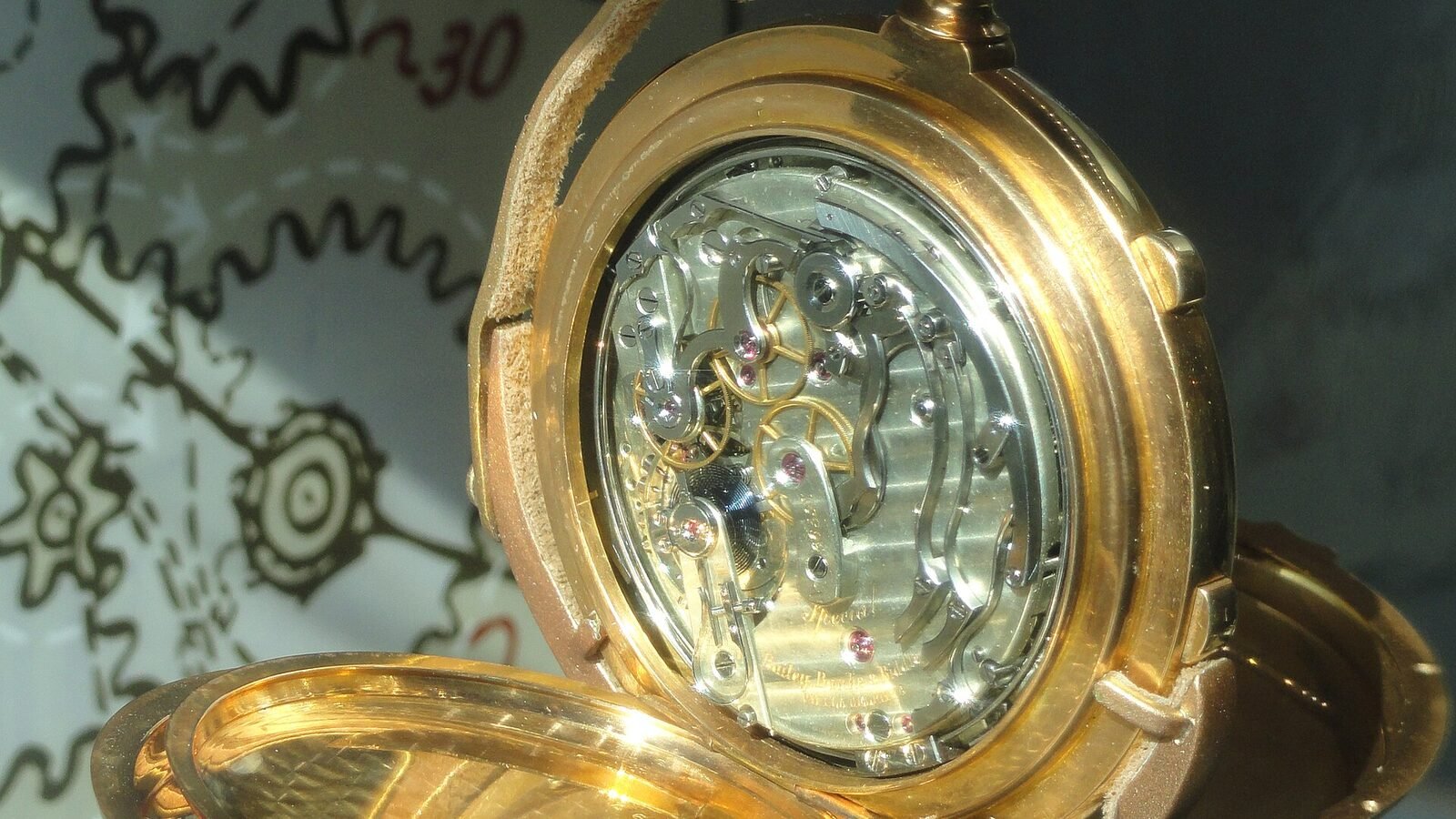
- Header. Patek Philippe minute repeater split-seconds chronograph, Geneva, circa 1895, from the Franklin Institute collection. Photograph by Daderot, released into the public domain.
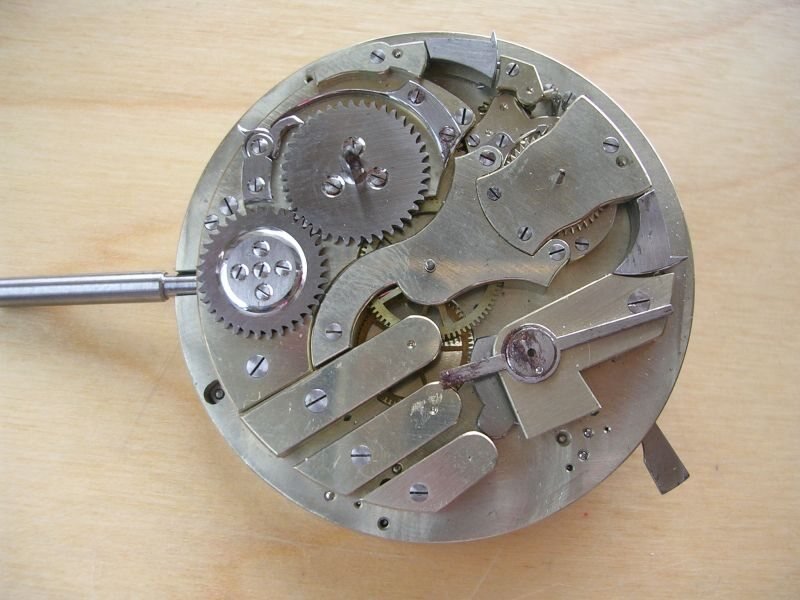
- Minute repeater movement. Photograph by Jjcasalo, licensed CC BY-SA 3.0.
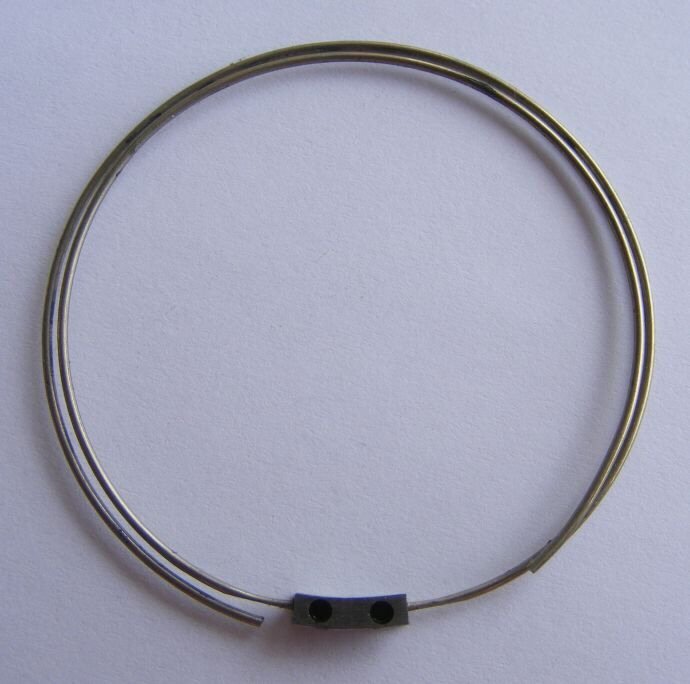
- Repeater gong. Wikimedia Commons contributor, licensed CC BY-SA 3.0.