A new independent house surfaces in Italy almost every season. Most do not last beyond a single prototype. Desder, based in Modena and founded by master watchmaker Luca Soprana and tattoo-artist-turned-designer Mo Coppoletta, has launched with something rarer than a single watch. The debut D001 reference carries an in-house triple-axis tourbillon caliber, displayed through a rotating cylinder system inspired by pre-war coachwork, and capped at six handcrafted pieces. The price is on request, which in this segment is a polite way of saying mid-six figures.
The People
Soprana is the technical hand. He trained in Switzerland, spent years inside complications ateliers, and is the watchmaker of record on the DSD_01 caliber. Coppoletta is the visual one. Long known in the design world through his London tattoo studio The Family Business and a career of collaborations with watch and lifestyle brands, he is responsible for the dial language, the case sculpture, and the typography. The two met in Modena, where Coppoletta has roots and where the workshop sits, a short drive from the engine factories of Maranello and Sant'Agata Bolognese. The Emilian setting is not incidental. It is the explicit conceptual frame.
The brand name itself comes from Emilian dialect. Desdér, roughly, means "to awaken" or "to be called into motion." The first watch is named for that idea, not for a movement number.
The Idea
Desder positions itself, in its own words, as standing against "industrial logic and serial production." That phrase is now a cliché in independent watchmaking, deployed by every micro-brand from Tokyo to Geneva. What separates Desder from the rest of the cliché is the implementation. The case is sculpted, not stamped. The movement is built in-house, not purchased from a movement supplier and personalised. The output is six pieces, not six hundred. The reference point is the Italian coachbuilders of the 1930s and the racing-car designers of the 1960s and 1970s, particularly the teardrop silhouettes of Touring Superleggera and the sculpted aluminium of Bertone, Pininfarina, and Scaglietti.
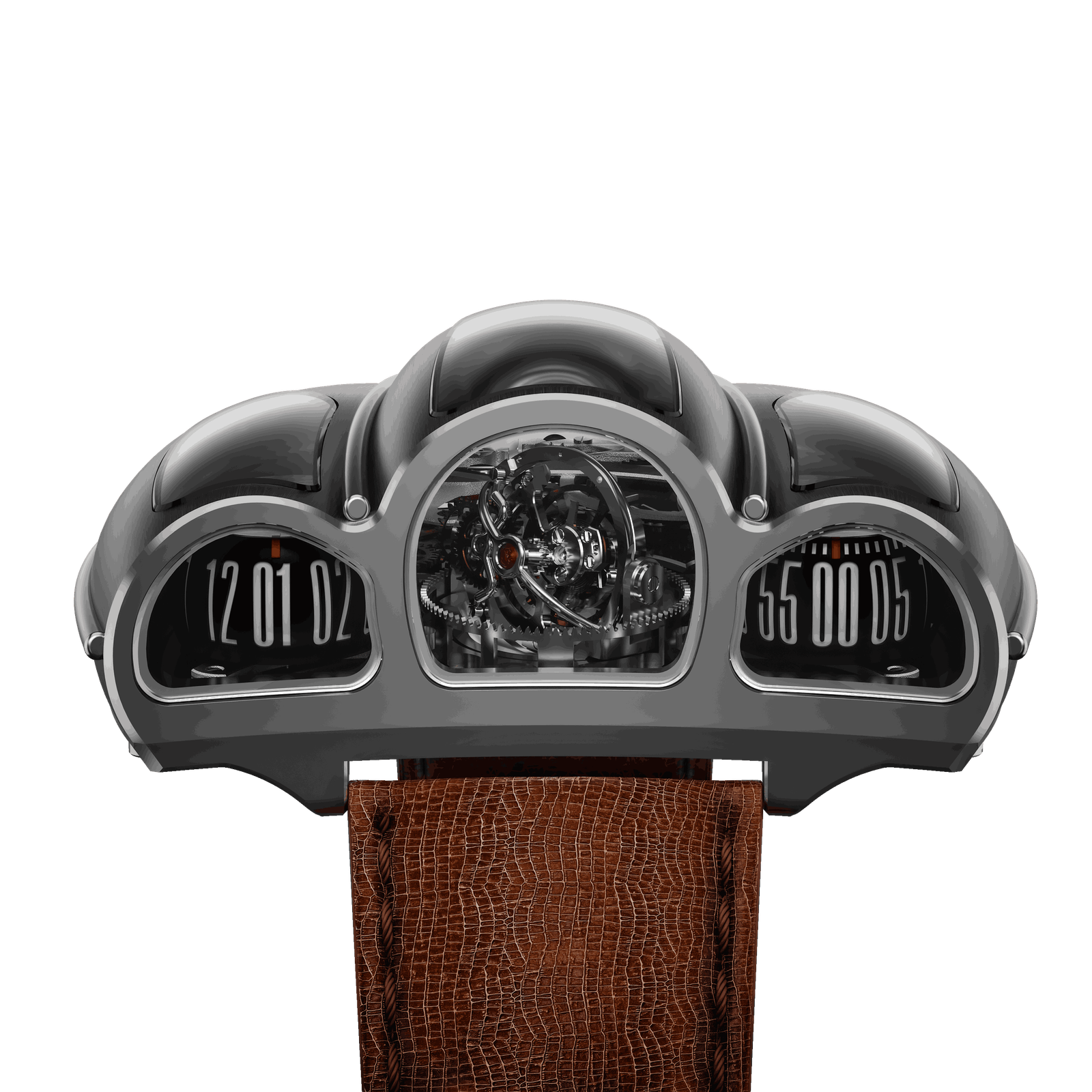
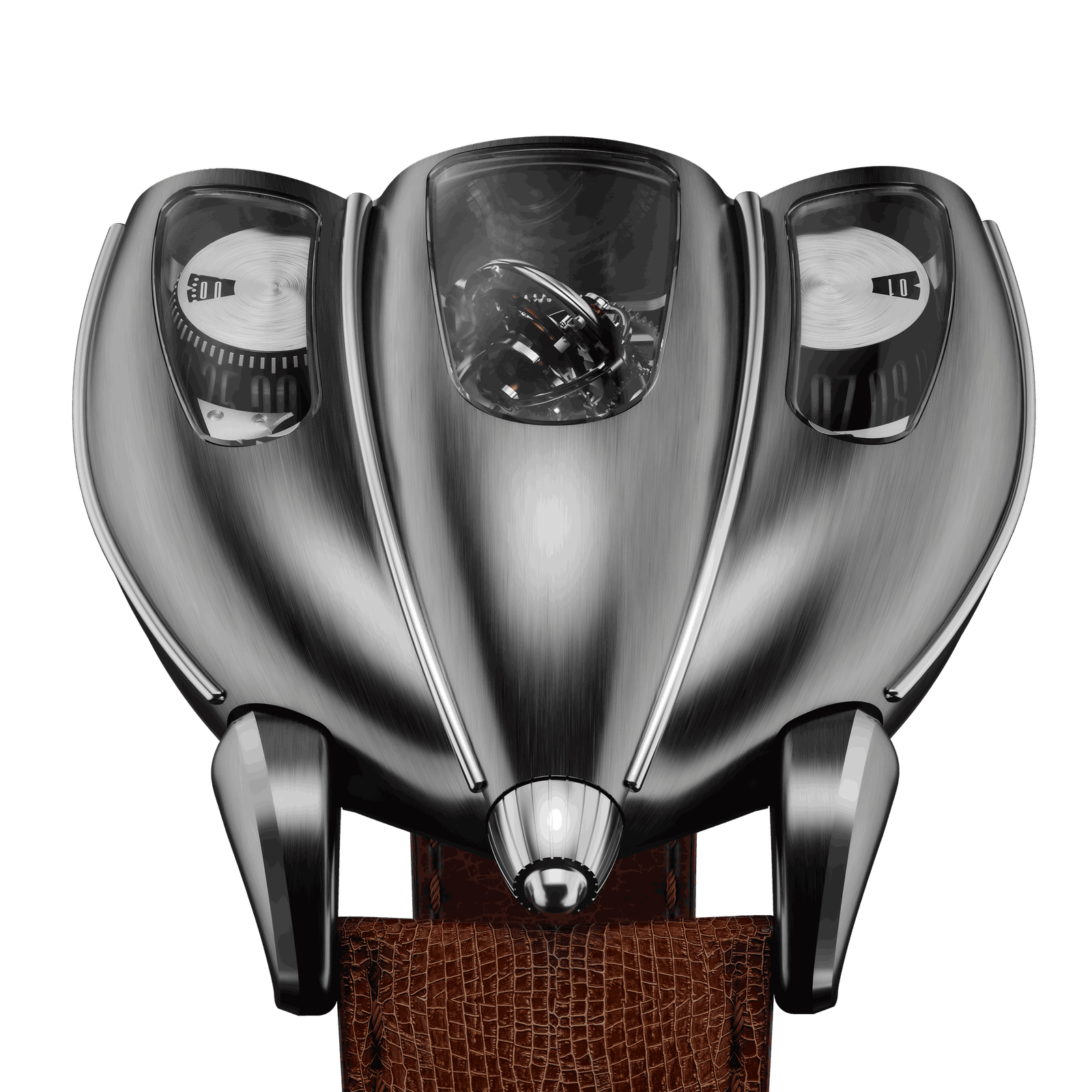
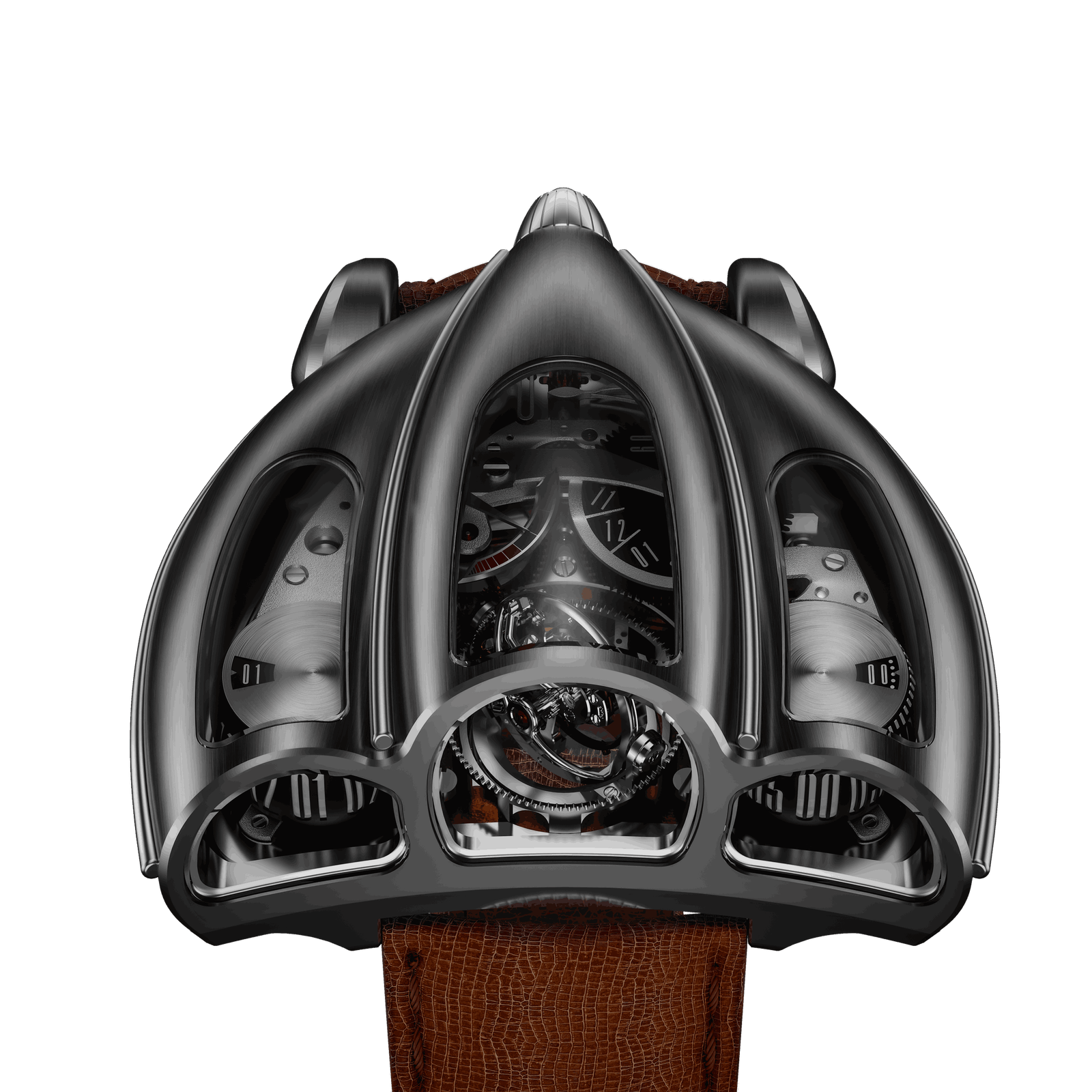
The watch is meant to read, on the wrist, as a piece of horological coachwork. The case is not round. It is a horizontal lozenge with two sweeping outer humps that house the cylinder displays, a sculpted central crown that frames the tourbillon, and a sharp drop at each end that recalls the rear fenders of a Lancia Aprilia or an Alfa 6C 1750. The brown alligator strap is fitted with a butterfly clasp that continues the case sculpting under the wrist.
The Display
Time is read through three apertures. The left drum shows the jumping hour, in a numeral that snaps cleanly to the next at the top of each hour, and a secondary reading through a smaller upper window for redundancy. The right drum shows continuous minutes, sweeping past a fixed reference. The central aperture houses the tourbillon cage and is, conceptually, a window into the engine rather than a time display.
Cylinder time-display is itself an unusual choice. The rotating drum, sometimes called a roller display, is mechanically more demanding than a standard hand-on-pinion because the entire mass of the drum and its printed numerals must be advanced at the right moment, with the right impulse, without disturbing the going train. The jumping action on the hour drum requires a separate energy buffer, similar in principle to the snail-and-star pattern used in jumping-hour pocket watches of the early twentieth century. The continuous minute drum, by contrast, rotates smoothly under direct gear drive.
The closest reference points are the historical Cortébert cylinder watches of the 1950s and, in the modern era, the various roller-display pieces from Urwerk, although Urwerk uses orbiting satellites rather than fixed drums. Desder's cylinders are not orbiting. They are stationary, mounted under the case humps, and the system reads more like an automobile dashboard than like a satellite display.
The Movement: DSD_01
The in-house caliber is the heart of the brand. The headline specifications are unusual on every line:
- Architecture: automatic, with a peripheral micro-rotor sized to fit under the central tourbillon assembly.
- Triple-axis tourbillon: the cage rotates on three orthogonal axes simultaneously, like a gyroscope. Cage rotation periods are not yet publicly published in full, but the construction follows the lineage of Greubel Forsey's Quadruple Tourbillon and Thomas Prescher's Triple Axis, both of which use nested cages to average out gravitational error in every possible wrist orientation.
- Complications: jumping hour, continuous minute, second time zone (GMT), and a power-reserve indication.
- Power reserve: 45 hours on a full wind.
- Frequency: 3 Hz (21,600 vph). Slower than the modern 4 Hz norm, faster than the 2.5 Hz vintage standard. The lower frequency is consistent with a complex tourbillon, where higher beats would tax the cage bearings and the going train.
- Jewels: 63. A standard time-only movement has 17 to 21. The high jewel count reflects the multiple bearings on the triple-axis cage, the drum supports, and the GMT differential.
- Finishing: hand-applied, with anglage on every bridge edge, polished countersinks, and black-polished steel for the central elements.
The microrotor is unusual on a triple-axis tourbillon. Most multi-axis tourbillon wristwatches are hand-wound, because the cage assembly occupies so much vertical space that there is little room left for an automatic winding system. Desder's decision to integrate a microrotor is a deliberate ergonomic choice, intended to make the watch wearable as a daily piece rather than as a vault object.
The Case
The case is built in Grade 5 titanium (Ti-6Al-4V), the aerospace-grade alloy used in modern haute horlogerie for its strength-to-weight ratio and its resistance to corrosion. Steel accents are fitted at the lugs and around the crown. The dimensions are 46mm wide and 24.8mm thick. Those numbers are large by modern standards but consistent with the architecture. A triple-axis tourbillon cage with three independent rotation periods cannot be flattened beneath about twelve millimeters of vertical space. The remaining height accounts for the drum displays, the microrotor, the GMT module, and the sapphire on both sides.
Where Desder Sits in the Independent Landscape
The market for new independent watchmakers has rarely been more crowded. Switzerland alone has launched dozens of micro-brands in the last decade. What distinguishes the credible ones is the answer to three questions. Who designed the movement. Who finishes it. How many will exist.
Desder's answer is, on the face of it, a strong one. The movement is genuinely in-house, by a watchmaker with a track record. The finishing is by hand, by the same workshop, in a small studio in Modena. The production is six pieces. By those three measures, Desder lands closer to the De Bethune, Urwerk, and MB&F end of the independent spectrum than to the kit-assembly micro-brands that dominate Kickstarter.
The closer reference points, mechanically, are:
- Greubel Forsey, Quadruple Tourbillon. The undisputed market leader in multi-axis tourbillon construction. Four nested cages, hand-finished to a standard nothing else in series production approaches. Retail above one million Swiss francs.
- Thomas Prescher, Triple Axis Tourbillon. The independent watchmaker who first commercialised the triple-axis architecture in a wristwatch, in 2003. Small-batch production.
- Franck Muller, Aeternitas Mega 4 (multi-axis tourbillon variant). High-complication piece in a more conventional case.
- Urwerk, UR-100 series. Closer in display philosophy, with rotating wandering hours and orbiting indices, although mechanically simpler.
- De Bethune, DB28 Steel Wheels Tourbillon. Closer in independent ethos and architectural ambition, with a similar emphasis on shaped cases and unconventional bridges.
What Desder adds to that lineage is a more visual, more sculptural, more Italian design language. Where most multi-axis tourbillon watches read as engineering studies, the D001 reads as a piece of design. That is the Coppoletta hand at work.
How To Read the Price
Desder lists the D001 as "price on request." That phrasing, in this corner of the market, almost always indicates a number above CHF 500,000 and below CHF 1.5 million. The reference points are:
- A new Greubel Forsey Double Balancier sits around CHF 350,000 to 450,000.
- The Quadruple Tourbillon retails above CHF 1,000,000.
- Urwerk UR-100 series retails between CHF 70,000 and 200,000 depending on case and finish.
- A Prescher Triple-Axis Tourbillon, when available, prices between CHF 250,000 and 500,000.
- A new MB&F Legacy Machine retails between CHF 100,000 and 300,000.
A six-piece, in-house triple-axis tourbillon with jumping hours, GMT, microrotor, and a hand-sculpted titanium case from a brand with no secondary-market history will almost certainly sit in the upper half of that range. The price is not the point. The point is the architecture and the production cap.
What To Watch Next
Three questions decide whether Desder becomes a name or stays a footnote.
One. Whether the second reference, when it comes, demonstrates a coherent design language that is recognisably Desder rather than recognisably Coppoletta. Brand languages are built on continuity, not on a single object.
Two. Whether the movement can scale into a small family of calibers, ideally a simpler hand-wound time-and-GMT version at a lower price point, so that the workshop is not eternally producing six tourbillons a year and nothing else.
Three. Whether Soprana's technical record stays clean over the long service life of these pieces. A triple-axis tourbillon with a microrotor is a mechanically dense object, and the long-term service infrastructure for a six-piece-per-year independent is, by definition, the founder himself.
The opening move is, by any honest measure, a strong one. A new Italian independent with an in-house triple-axis tourbillon, sculptural coachwork-inspired case, and a credible technical lead is a rare event in modern watchmaking. The next two references will determine whether Desder belongs in the conversation with the established Swiss independents or remains a Modena curiosity.
Specifications, At a Glance
- Reference: D001
- Case: 46mm, 24.8mm thick, Grade 5 titanium with steel accents
- Crystal: Sapphire, front and back
- Movement: DSD_01, automatic with peripheral microrotor
- Frequency: 3 Hz (21,600 vph)
- Power reserve: 45 hours
- Jewels: 63
- Functions: Jumping hour, continuous minute (cylinder displays), triple-axis tourbillon, GMT, power reserve
- Strap: Brown alligator with butterfly clasp
- Production: 6 pieces total
- Price: On request
- Origin: Modena, Italy
Image Credits
All photography is from the official Desder press kit, used for editorial purposes. Brand portrait, technical details, and dimensional data are taken from the manufacturer's public material as of 2026.