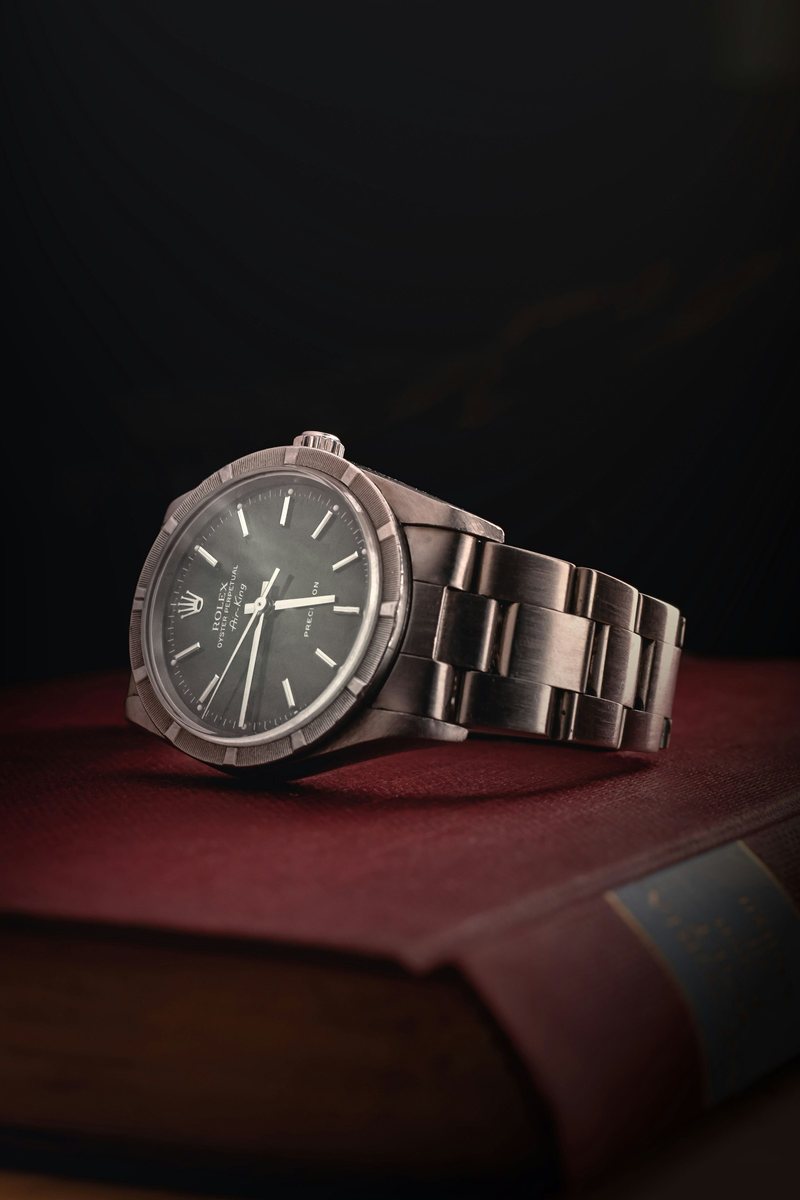
The Explorer is the plainest watch Rolex makes, and the only one whose entire design brief is legibility. Our database holds Explorer listings across 12 references with three or more examples, with specification records tracing five calibre generations and, unusually, a case size that shrank and then grew again. This article follows the mechanical and dimensional history, then examines what the market pays for a watch with no bezel, no date and no complication.
The design brief: subtraction as a specification
The Explorer's defining features are absences. No rotating bezel, no date, no cyclops lens, no chronograph. What remains is a matte black dial with applied 3, 6 and 9 numerals, a triangular marker at 12, and hands sized for contrast rather than elegance.
Those Arabic numerals at 3, 6 and 9 are the model's signature and a genuine legibility decision. At a glance the eye needs anchor points; numerals at the quadrants provide unambiguous reference in a way that batons do not, particularly in low light or with partial vision of the dial. Our data records these separately as "Arabic dial" variants, and they price at a small premium: the 124270 Arabic dial averages $9,050 against $8,880 for the standard reference.
Five calibre generations, traced through our specification data
The Explorer's movement history maps the last thirty years of Rolex development:
- Calibre 3000 (14270): 42-hour reserve, 36mm case. The workhorse of the early 1990s.
- Calibre 3130 (114270): 42-hour reserve, 36mm. Added a full balance bridge in place of a balance cock, improving shock resistance.
- Calibre 3132 (214270): 48-hour reserve, 39mm. Introduced Paraflex shock absorbers, which Rolex rates as roughly 50 percent more shock resistant than the previous system.
- Calibre 3230 (124270): 70-hour reserve, back to 36mm. Chronergy escapement.
- Calibre 3285 (226570, Explorer II): 70-hour reserve, 42mm, with the GMT function.
The pattern worth noting is that the Explorer received the Chronergy escapement and 70-hour barrel at the same time as the professional models, despite being the entry point to the sports range. Rolex did not reserve the improvement for its more expensive watches.
The sizing reversal, and why it matters commercially
Most watch lines have grown monotonically since 1990. The Explorer did not. Our specification data shows the sequence plainly: 36mm (14270, 114270) → 39mm (214270) → 36mm (124270).
The 2010 move to 39mm followed the industry; the 2021 return to 36mm reversed it. This is one of very few instances of a major manufacture publicly conceding that a size increase was wrong for a particular design. On a watch whose brief is legibility rather than presence, 36mm is arguably the correct answer, and the current reference says so.
The market has not obviously rewarded either choice. The 39mm 214270 averages $9,054 and the 36mm 124270 averages $8,880, a difference of under 2 percent, which is inside the noise. Buyers appear to treat them as equivalent and choose on wrist size.
What the market pays
| Reference | Configuration | Calibre | Listings | Average ask | Observed range |
|---|---|---|---|---|---|
| 216570 | Explorer II, 42mm | 3187 | 45 | $13,254 | $7,738 to $106,249 |
| 226570 | Explorer II, 42mm, current | 3285 | 47 | $12,583 | $8,500 to $14,800 |
| 216570-0001 | Explorer II, white dial | 3187 | 8 | $11,594 | $10,145 to $13,120 |
| 224270 | Explorer 40mm | 3230 | 22 | $10,050 | $7,380 to $11,211 |
| 16570 | Explorer II, 40mm, tritium era | 3185 | 62 | $9,533 | $6,593 to $18,675 |
| 224270 Arabic | Explorer 40mm, Arabic dial | 3230 | 10 | $9,546 | $8,757 to $9,965 |
| 214270 | Explorer 39mm | 3132 | 22 | $9,054 | $6,480 to $10,874 |
| 124270 Arabic | Explorer 36mm, Arabic dial | 3230 | 11 | $9,050 | $8,177 to $10,311 |
| 124270 | Explorer 36mm, current | 3230 | 20 | $8,880 | $6,450 to $11,000 |
| 214270 Arabic | Explorer 39mm, Arabic dial | 3132 | 39 | $8,546 | $7,071 to $10,432 |
| 114270 Arabic | Explorer 36mm, Arabic dial | 3130 | 18 | $7,460 | $5,637 to $9,970 |
| 114270 | Explorer 36mm | 3130 | 15 | $7,183 | $6,480 to $8,227 |
Asking prices from our live listing database, $3,000 to $300,000 band, minimum three listings per reference. Updated nightly.
Three findings
The Explorer is the cheapest route into a modern Rolex sports movement. The 124270 averages $8,880 and carries the calibre 3230 with a 70-hour reserve and Chronergy escapement, the same core architecture as the calibre 3235 in a Submariner averaging around $14,875 in our data. The buyer forgoes the rotating bezel, the date and 100 metres of water resistance, and saves roughly 40 percent.
The 216570 range signals a variant problem, not a condition problem. Forty-five listings averaging $13,254 with a top observation of $106,249. That upper figure will be a gem-set or otherwise non-standard example; the honest read of the 216570 market is the clustering around $10,000 to $13,000, and any single high listing should be treated as a separate watch rather than evidence of the reference's value.
Tritium-era Explorer IIs are appreciating quietly. The 16570 averages $9,533 with a range to $18,675 across 62 listings, the largest sample in the family. It ran from 1989 to 2011, spanning tritium and later luminous compounds, and the upper half of that range is where the early tritium dials sit.
Auction context
Confirmed results in our auction data show where vintage Explorer money concentrates:
- Ref. 1016, the definitive vintage Explorer, estimate HK$160,000 to 320,000, realized HK$381,000.
- Ref. 1655, the original Explorer II with its orange 24-hour hand, estimate HK$190,000 to 350,000, realized HK$330,200.
The 1016 result is the reference point for the family. Produced from 1963 to 1989, it is the watch the modern 36mm Explorer is designed to echo, and it trades at roughly forty times the current reference's price. Both results landed within or modestly above estimate, which suggests a mature, well-understood vintage market rather than a speculative one.
Practical guidance
If you want current Rolex movement technology at the lowest cost, the 124270 is the answer in our data and it is not close. Choose between 36mm and 40mm on wrist size rather than value, since the market prices them within 2 percent of each other. For the Explorer II, the current 226570 shows a notably tight range ($8,500 to $14,800 across 47 listings) making it easy to price confidently, while the outgoing 216570 requires you to establish exactly which variant you are looking at. For the 16570, the dial's luminous generation is the value driver.
Live Explorer listings are on our Explorer listings page, with realized prices on our auction results page. Current specifications including Paraflex and Chronergy details are published by Rolex.
Methodology
Listing figures aggregate our own nightly collection, filtered to a $3,000 to $300,000 sanity band with a minimum of three listings per reference. Calibre, case diameter and power reserve data come from our reference database. Auction figures are realized prices including buyer's premium as reported by the house, in the sale's original currency. Full approach on our methodology page.