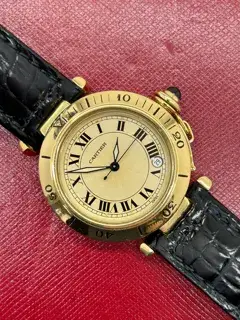
Cartier is the only major house whose watches are collected primarily for their geometry, and our data shows the market pricing that principle with unusual clarity. Across 1,901 Cartier listings the difference between model families is not driven by movement, complication or metal, but by case shape: the Crash averages $266,667 while the Santos averages $9,349. Both are steel-and-gold Cartiers with simple time-only movements. This article examines what actually creates that 28-fold gap.
Why Cartier's history is a case-shape history
Cartier's contribution to watchmaking was not mechanical. The house bought movements from Jaeger, LeCoultre, Piaget, European Watch & Clock Co. and later ETA, and concentrated its own effort on form. That produced a sequence of shapes that have no real parallel elsewhere: the Santos (1904), designed for the aviator Alberto Santos-Dumont, who needed to read time without releasing the controls; the Tank (1917), whose brancards echo the track housing of a Renault FT; the Crash (1967), whose asymmetric case has never been convincingly explained by the house itself.
The consequence for collectors is that Cartier value attaches to the case in a way it does not for Rolex or Patek, where reference numbers encode movement generations. A Cartier reference primarily encodes a shape, a size and a metal.
The market by family
| Family | Listings | Average ask | Highest observed |
|---|---|---|---|
| Crash | 10 | $266,667 | $350,000 |
| Panthère | 215 | $14,200 | $169,500 |
| Tank | 366 | $12,627 | $194,850 |
| Pasha | 167 | $9,525 | $105,696 |
| Santos | 552 | $9,349 | $62,800 |
| Ballon Bleu | 73 | $8,100 | $36,000 |
Asking prices from our live listing database, $2,000 to $400,000 band. Updated nightly.
The Crash: scarcity as the entire argument
Ten listings against 552 for the Santos is the whole story. The Crash has been produced in small, sporadic series since 1967, London-made originals in the late 1960s, Paris re-editions, and limited runs since. There is no meaningful mechanical difference from a Tank of the same period; both typically carry a simple manually wound or quartz movement.
Our auction data confirms the ceiling: a Cartier ref. CRHPI01088 Crash carried an estimate of HK$1,000,000 to 2,000,000 and realized HK$9,207,500, 360 percent above the high estimate. That is the largest estimate overshoot in our entire Cartier dataset, and it happened on a watch whose value is entirely its silhouette.
Santos: the volume family, and the one with real engineering news
At 552 listings the Santos is Cartier's most liquid line, and the WSSA-prefix references in our data (WSSA0018 at $8,128, WSSA0029 at $7,524, WSSA0062 at $8,347) are the current generation. This is also the family where Cartier did something genuinely technical.
The current Santos introduced two mechanisms worth naming. QuickSwitch is a spring-loaded bar under the case that releases the bracelet without tools. SmartLink allows bracelet links to be added or removed by depressing a button on each link, again without tools or pins. These sound like conveniences and are, but they solve a real problem in an integrated-bracelet watch, where sizing traditionally requires a watchmaker.
Note the price consistency: the WSSA references cluster between $6,410 and $8,347 with tight individual ranges (WSSA0046 spans just $7,595 to $8,550 across eight listings). That is what a well-understood, non-speculative market looks like, and it stands in deliberate contrast to the Crash.
Tank: one name, many watches
The Tank at 366 listings averages $12,627 but reaches $194,850, and that spread reflects a naming convention rather than a condition problem. "Tank" covers the Tank Louis Cartier, Tank Française, Tank Américaine, Tank Must, Tank Solo and the Cintrée, watches spanning quartz Must-era pieces at a few thousand dollars to platinum Cintrée re-editions.
For a buyer this means the family average is close to useless. The relevant comparison is always within a specific sub-model and case metal.
Where Cartier's true top end sits: not wristwatches
The most instructive finding in our Cartier auction data is that the highest results are not watches at all:
- La Pendule Magnétique, estimate not published, realized HK$14,970,000.
- Portico Mystery Clock, estimate not published, realized CHF 3,932,000.
- La Pendule Art Déco, estimate HK$1,200,000 to 2,400,000, realized HK$2,921,000.
- Modèle A mystery clocks, two results at HK$5,016,500 and HK$4,572,000.
Cartier's mystery clocks, first made from 1912, suspend the hands in a rock-crystal dial with no visible connection to the movement. The mechanism is concealed in the base and frame, driving two transparent discs whose toothed edges are hidden by the bezel. The hands appear to float.
This matters for understanding the brand. Cartier's supreme technical achievements are in clockmaking and stone-setting, not in wristwatch movements, and the auction market prices them accordingly, several multiples above any Tank or Santos.
Practical guidance
For a wearable Cartier bought on merit, the current Santos is the strongest case in the range: our data shows the tightest price bands of any family, and QuickSwitch and SmartLink are genuine functional advances. For the Tank, identify the exact sub-model and metal before treating any price as comparable. For the Crash, understand plainly what you are buying: a shape with almost no mechanical content and an auction record that has repeatedly quadrupled specialist estimates.
Live Cartier listings are on our Cartier listings page, with realized prices on our auction results page. Current specifications and the QuickSwitch and SmartLink systems are documented by Cartier.
Methodology
Listing figures aggregate our own nightly collection, filtered to a $2,000 to $400,000 sanity band. Family groupings are derived from model names in listing titles. Auction figures are realized prices including buyer's premium as reported by the house, shown in the sale's original currency. Full approach on our methodology page.


